Professional development certificate: 2026 guide
What a professional development certificate proves, how employers judge one, and how to design, issue, and verify certificates that hold up in hiring.
Mia Carter
Co-founder & CEO, CertSeal
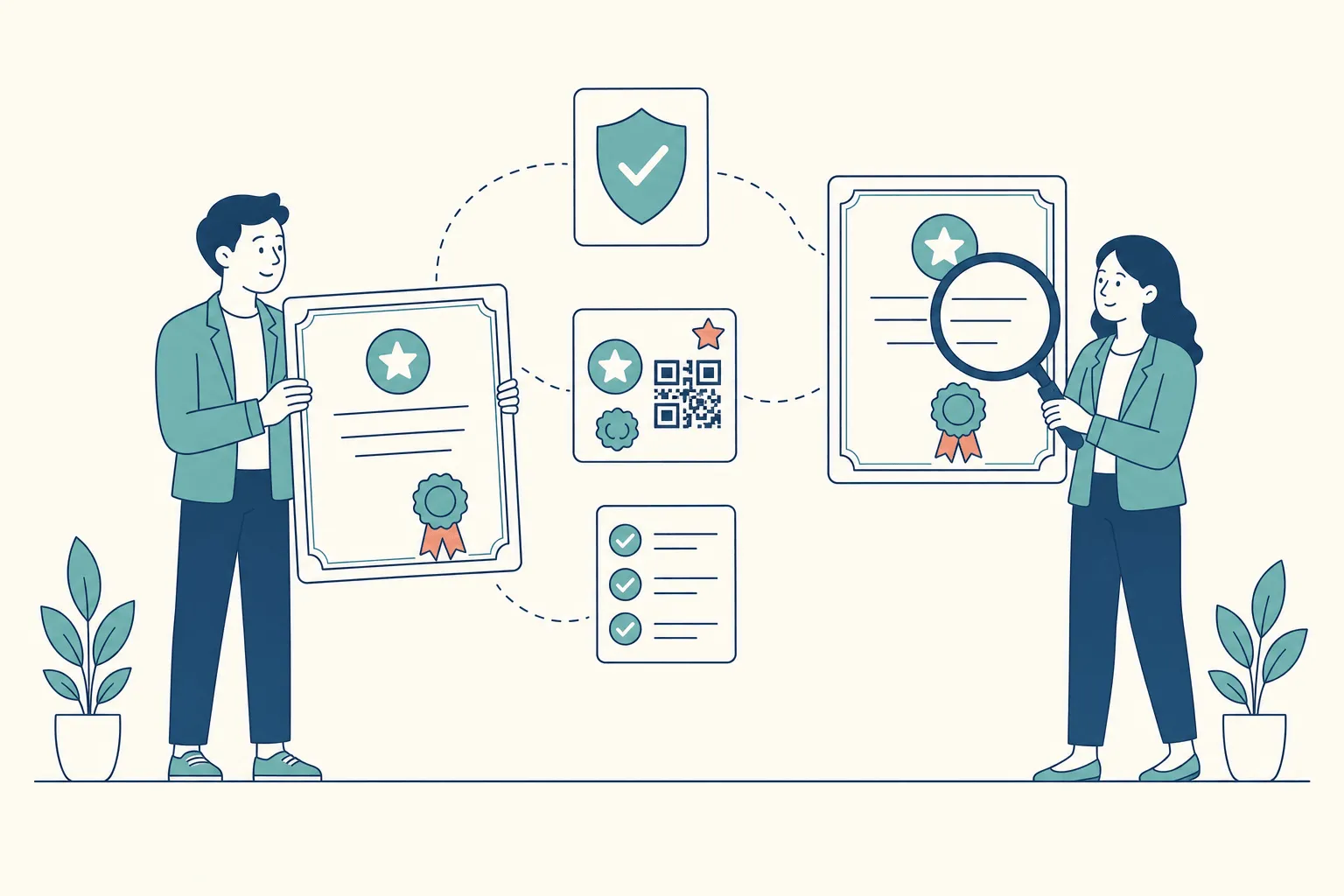
The United States now offers 1,850,034 unique credentials from more than 134,000 providers, according to Credential Engine’s Counting Credentials 2025, and 486,352 of them are certificates. In a field that crowded, a professional development certificate can’t be judged by its title or its design alone. Its value depends on what it proves, who issued it, how the learner was assessed, and whether an employer can check the claim and understand it.
That scale creates a counterintuitive problem. More credentials give learners more ways to show their development, but they also make it harder for employers to tell a rigorous competency signal from a record of attendance. Even counting who holds one is unsettled. A 2018 New America report found three federal surveys putting the share of U.S. adults with a certification or license anywhere between 17% and 22%. The Bureau of Labor Statistics puts it at 24.0% of employed people in 2025, but most of that is occupational licensing: only 2.5% held a certification without a license.
For training leaders, the practical question isn’t whether to issue a certificate. It’s whether the certificate makes a credible, portable claim. For employers, it’s whether that claim carries enough evidence to support a hiring or development decision.
A certificate is a claim, not a decoration. The design gets it read. The evidence behind it decides whether anyone believes it.
This guide covers both sides of that exchange: what a professional development certificate actually represents, how credentialing moved from attendance records to competency evidence, what the labor-market research says, how verification works, what employers inspect, and a decision matrix for designing certificates that hold up. If you’re building a new program from scratch, how to launch a certification program covers the governance side in more depth.
What a professional development certificate represents
A professional development certificate is a claim. The document is only the visible layer. The credential is the statement underneath it: this named person completed a defined learning experience, demonstrated a stated level of knowledge or skill, or both. If that statement is vague, the certificate can look polished and still carry little weight. If it’s precise and supported, employers can read it and trust it.
That’s why issuers and employers face the same document from opposite sides. The issuer has to write a claim that is clear, bounded, and defensible. The employer has to decide whether the claim is meaningful enough to inform hiring, promotion, or internal development. Good design helps readability, but trust comes from how the claim is structured and whether someone else can verify it.
Every certificate stands for four connected things, as what is a certificate? explains in more detail:
- A formal claim. What, exactly, did the learner complete or demonstrate?
- Learner competence. Which knowledge, skills, or performance outcomes does the credential stand for?
- Issuer authority. Why should an employer rely on the organization making the claim?
- Signal quality. Can someone else interpret, verify, and compare the credential without guesswork?

The terms that cause confusion
The vocabulary around credentials causes much of the trust problem. Credential is the umbrella term: it covers certificates, certifications, licenses, degrees, microcredentials, and digital badges. The labels are related, but they aren’t interchangeable.
- A license is typically required by law to do regulated work.
- A certification usually means an independent body has assessed and validated competence, and it often has to be renewed.
- A certificate usually records completion of an education or training program, though some certificate programs also assess learning.
- A digital badge is a visual marker of an achievement. It works best when it links to evidence and a verification page.
- A microcredential usually represents a narrower skill or outcome.
Those differences matter because each category means something different in the labor market. A completion certificate should never imply legal authority to practice or independent professional certification. Digital badges vs digital certificates covers when each format fits.
Practical rule: name the achievement precisely. If the learner completed instruction, say that. If the learner passed an assessment, say what the assessment measured. Don’t call anyone “certified” when the program only confirms attendance.
Precise naming does more than avoid confusion. It helps learners explain what they achieved, and it lets recruiters, managers, and auditors judge the claim on its merits.
How certification moved from attendance proof to competency evidence
Credentials became more credible when they stopped treating presence as proof of ability. For years, many professional credentials worked like stamped attendance records. They confirmed that someone showed up, logged the hours, or sat through instruction. That supports compliance and record-keeping, but employers usually need a different answer. They need evidence about performance.
This is the dual problem at the center of certificate design. Issuers decide what claim a credential makes. Employers decide whether it deserves belief. More certificates in circulation don’t close that gap. Clear verification rules and defensible evidence do far more than polished artwork, a badge graphic, or a QR code.
The history of applied behavior analysis is a useful example. According to a history of the field’s credentialing published in The Behavior Analyst, the first efforts to identify practitioners with a specified level of expertise began in the early 1970s. When Florida began teaching its behavior-analysis curriculum in two-day workshops in the late 1970s, the credential was partly an incentive to get staff to attend. That state program grew into the Certified Behavior Analyst credential, and later into the national Behavior Analyst Certification Board, established in 1998. The pattern repeats across many fields. Attendance markers come first because they’re easy to issue. Competency evidence comes later because it requires agreement on standards, assessment, and governance.
Four practices that made the claim stronger
The same history credits Florida’s program as the first to combine four practices, and program managers can borrow all of them.
- Competency task lists based on job analysis. Start with the work itself. A credential carries more weight when the issuer can show which tasks the role requires and what knowledge supports competent performance. Without that blueprint, a curriculum reflects instructor preference more than the job.
- Psychometrically designed examinations. The assessment has to measure the intended capability, consistently. A quiz on course vocabulary shows participation and short-term recall. It doesn’t show that someone can do the job.
- Standardized exam administration. Consistent conditions reduce avoidable variation between candidates, and they give the issuer a defensible answer when an employer, auditor, or regulator asks how results were produced.
- Passing scores set with subject-matter experts. A passing mark should represent the threshold for minimally competent practice. Practitioners help tie that threshold to real work rather than to course completion. Today the BACB sets its passing scores with the modified Angoff method, using a panel of certified subject-matter experts.
In 2009, the BACB developed a model licensing act, revised in 2012, that encouraged states to make its certification a prerequisite for licensure applicants. Nevada and Oklahoma passed the first behavior analyst licensure laws that same year, and by July 2024 38 states licensed behavior analysts. That progression matters. A profession-led credential can shape regulation once its competency definitions, examinations, and governance are credible enough to support public protection.
You don’t need a psychometrics team to apply the lesson to a professional development certificate. Make the claim narrow enough to defend, then document the evidence well enough for someone else to check it. Completion of course certificates shows how to separate proof of attendance from proof of completed, assessed learning.
What professional certificates are worth in the labor market
Labor-market value is uneven by design. A professional development certificate can help one learner land a job, mean little for another, and leave an employer unsure what was checked. That split matters because issuers tend to count completions, while employers are trying to decide whether a credential deserves trust.
A study by Baird, Bozick, and Zaber, published in the IZA Journal of Labor Economics and reviewed by the U.S. Department of Labor, shows how uneven it gets. Using 2015–2016 Current Population Survey data and an instrumental-variable design, it found that certifications and licenses both significantly increased employment for workers without a bachelor’s degree, and that credentials raised those workers’ hourly earnings by a statistically significant margin.
The picture changed for workers with a bachelor’s degree or higher. A license raised their probability of employment by about 4%. A certification had no statistically significant effect on their employment or earnings.
Raw pay data shows why learners keep pursuing credentials anyway. In 2025, full-time workers with a certification or license earned a median $1,460 a week, against $1,131 for those without, according to the Bureau of Labor Statistics. Treat that gap with care: the medians mix licensed professions in with everyone else, so they aren’t causal estimates of what any one certificate is worth.
Why aggregate outcomes mislead
Program teams often make a category error here. They treat every certificate as if it works the same way in the labor market, putting attendance badges, occupation-specific certifications, and licenses in one box and expecting one outcome. A completion count can look strong while employer recognition stays weak. Learner satisfaction can stay high while the credential is too vague to influence screening or pay.
Participation figures cause the same confusion when definitions shift. Some surveys combine certifications and licenses, others count only certification holders, and they sample different populations. Read headline prevalence numbers carefully before comparing one dataset with another.
For issuers, the practical lesson is to evaluate the credential where decisions are actually made: for a specific learner group, in a specific occupation, with a specific kind of assessment and a recognizable claim. For employers, the parallel question is what the certificate lets them infer about capability, and what it leaves unknown.
A useful evaluation frame separates the moving parts:
| Evaluation lens | Question to ask |
|---|---|
| Learner background | Does the credential serve people with different education levels the same way? |
| Credential type | Is this a completion certificate, an occupational certification, or a license? |
| Target occupation | Do employers in the intended field recognize the skill signal? |
| Employment status | Does the program help job seekers, employed learners, or both? |
| Evidence of competence | What assessment result supports the claim? |
A certificate’s value depends on the fit between the learner, the occupation, the credential design, and the employer’s decision process. Issuers can make that fit visible by attaching structured information: competency domains, assessment method, issuing organization, expiry, and target occupation. Those fields help evaluators compare outcomes accurately, and they help employers tell whether two credentials that look alike on screen make the same claim.
Building machine-verifiable credentials with modern standards
A portable credential needs more than a downloadable file. It should let a verifier confirm that the issuer made the claim and that nobody altered it afterwards.
The W3C’s Verifiable Credentials Data Model 2.0, a W3C Recommendation since May 2025, defines a verifiable credential as “a tamper-evident credential whose authorship can be cryptographically verified.” It describes a three-party ecosystem: the issuer signs the credential, the holder presents it, and the verifier checks the proof. The standard is also careful about what that proof covers: “Verifiability of a credential does not imply the truth of claims encoded therein.” Once a credential checks out as authentic and current, the verifier still applies its own business rules before relying on it.

A practical architecture
Start with stable claims. Define fields for the recipient, achievement, issuer, issue date, and expiry date where relevant. Add competency domains, assessment method, result or status, and target occupation when they help interpretation.
Sign the credential. A digital signature binds the claim to the issuer’s identity and makes alteration detectable. In the W3C model the credential is expressed as structured data with an embedded or enveloping proof. Simpler systems sign the issuance record that a hosted verification page reads from.
Give the holder a usable presentation. A recipient might share a wallet credential, a verification page, a QR code, or a persistent URL. Whatever the format, people and verification software both need to be able to read it.
Check status, not just authenticity. Employers need to know whether a credential is still active, has expired, or was revoked. A live status check is more reliable than treating a static PDF as valid forever.
Protect the operational record. Document key rotation, keep audit trails for issuance and re-issuance, and set revocation procedures before you need them. These controls matter when staff change, keys are compromised, or a credential needs correcting.
A QR code or URL only helps someone find the credential. It doesn’t create trust by itself. Trust comes from the signed claims and from the verifier checking the issuer, the current status, and its own rules. Dynamic QR codes for verifiable credentials explains what a QR code should point to, and credential verification services, compared shows how platforms handle the mechanics.
The employer judgment problem nobody talks about
Wider adoption hasn’t solved the employer’s interpretation problem. In SHRM’s research on the skills-first movement, 78% of HR professionals said skilled credentials are used sometimes, often, or almost always in their hiring processes in 2025, up from 72% in 2021. Yet 24% of HR professionals, 26% of HR executives, and 33% of supervisors said it is too difficult to determine the quality of the skills those credentials represent. The surveys ran in October 2025 and covered more than 1,100 HR professionals and 1,200 supervisors.

The paradox is plain. Employers want skill evidence, but a certificate that only shows a course name and a completion date leaves the important questions unanswered. Who assessed the learner? Was performance independently checked? Did the assessment test recall, applied performance, or both? Is the issuing organization recognized beyond its own learning platform?
What employers should inspect
A useful due-diligence review compares certificates from universities, employers, professional associations, and private providers using the same questions:
- Assessment validity. Does the assessment measure the stated competency?
- Assessment ownership. Who designed and scored it?
- Practical evidence. Did the learner complete a project, demonstration, simulation, or work sample?
- Instructor expertise. Do instructors have relevant occupational experience?
- Industry alignment. Did employers or practitioners help define the competency?
- Curriculum recency. Does the provider update content when tools, regulations, or practices change?
- Credential scope. Does the certificate represent course completion, assessed mastery, or independent certification?
- Verification access. Can a recruiter confirm the issuer, learner, achievement, and status without friction?
A recognizable logo can open the conversation. Transparent evidence decides whether the credential deserves trust.
Even employers who value credentials weigh them alongside other evidence. In a 2025 survey of 502 HR and recruiting leaders, run by Mantis Research for the credentialing platform Accredible, 46% called relevant digital credentials essential to hiring decisions and 51% called them nice to have. That doesn’t make professional development certificates irrelevant. It means issuers should position them as one part of an evidence package that also includes experience, interviews, portfolios, references, and work samples.
The quality question should shape certificate design from the start. If an issuer can’t explain what the learner demonstrated, an attractive badge won’t repair the signal.
Making credentials visible in real hiring workflows
Issuing the certificate is only half the job. The recipient has to put it where recruiters look, describe the assessed capability in language they understand, and make verification instant.
The appetite is there. In the same Accredible survey, 91% of HR and talent leaders said they intentionally look for digital credentials when reviewing applications, 86% said they’d be more likely to interview a candidate whose credential proved a key skill, and 63% had hired someone partly because of one. Yet fewer than half (46%) regularly see them on resumes. Recruiters value the signal and still miss it, because candidates don’t present it consistently.
Turn the certificate into evidence
On a resume, place the credential near the relevant skills or professional development section, and lead with the assessed capability, not just the course title. “Completed data analysis training” is weaker than a line that names the skill demonstrated, the assessment, the issuer, and where to verify it.
On LinkedIn, add the credential to the Licenses & certifications section with its verification URL. In a portfolio, connect the certificate to a project that shows the skill applied. In an interview, explain the task, the assessment, and the outcome rather than reciting the credential’s name.
Candidates can also include the verification link in applications, email signatures, and project profiles. The link should open without an account and work on a phone. A recruiter shouldn’t have to download an unfamiliar file or email the issuer to confirm a basic claim.
Verification is the other half of the gap. 84% of the same leaders had suspected or discovered that a candidate exaggerated or misrepresented their qualifications, and 39% said it’s hard to verify whether the information on a resume is accurate. Asked what would make digital credentials easier to use or trust, their top answer was integration with applicant-tracking systems and HR platforms (60%). Structured, verifiable information helps issuers and recipients alike: a clear claim with a working verification link is easier for people and systems to find and interpret.
Designing and verifying professional development certificates that earn trust
A trustworthy certificate starts with a design decision, not a template. Before you launch a program, define the claim, identify the evidence behind it, and plan how a third party will verify the result.
Use this decision matrix during program approval:
| Dimension | Questions before launch | Implementation choice |
|---|---|---|
| Competency mapping | What can the learner do after completion? Which job tasks does it support? | Map outcomes to observable knowledge or performance statements. |
| Assessment validity | What evidence shows achievement? Does the assessment match the stated skill? | Use projects, demonstrations, exams, or structured reviews that fit the claim. |
| Issuer credibility | Why should an employer trust this organization? | Publish governance, instructor qualifications, standards, and who owns the credential. |
| Verifiable metadata | Can a verifier identify the learner, issuer, achievement, dates, and status? | Use signed records, persistent verification pages, and clear expiry or revocation status. |
| Recipient presentation | Can learners share the credential where recruiters already look? | Provide mobile-friendly pages, persistent URLs, QR codes, and copy-ready skill wording. |
| Employer interpretability | Can a hiring manager understand the level and scope quickly? | State the assessment method, competency domains, prerequisites, and intended use. |
| Portability | Can the credential outlive the platform and the learner’s relationship with you? | Use durable links, exportable records, and open standards where a partner requires them. |
How to design a certificate that looks professional turns the presentation rows into layout, typography, and a legible verification block. The operational system matters just as much. If you reissue a credential, the old record should show its new status. If a credential expires, the verifier should see that status rather than relying on a printed date.
Where CertSeal fits
For teams that issue professional development certificates repeatedly, CertSeal covers the operational side of that matrix. You design templates in the certificate maker, issue in bulk from a CSV file, Google Sheets, the REST API, or Zapier, and every credential gets a unique verification URL and dynamic QR code that an employer can check without an account. Credentials are cryptographically signed, revocation and re-issuance are built in, and the verification page always shows current status rather than the status on the day of issue. Expiry dates and engagement analytics are available from the Plus plan up, and recipients can add a credential to their LinkedIn profile in one click.
It’s worth knowing the boundary, too. CertSeal issues verifiable PDF and PNG certificates with hosted verification, not Open Badges 3.0 or W3C Verifiable Credentials for digital wallets. If a registrar, regulator, or partner requires wallet-format credentials, put that at the top of your requirements list.
Whatever tool you choose, keep the core standard intact: the recipient should own a usable copy, and an employer should be able to verify the issuer, skill, assessment, issue date, and current status without depending on visual polish.
Frequently asked questions
What is a professional development certificate?
It’s a record, increasingly a digital credential, that a person completed a defined professional learning experience, and sometimes that they passed an assessment of the skills it covered. Training providers, employers, professional associations, and universities issue them. They’re usually narrower and shorter than a degree, and they focus on skills someone can apply at work.
Is a professional development certificate the same as a professional certification?
Usually not. A certificate generally records completion of a course or program run by the issuer. A certification generally means an independent body assessed competence against a published standard, often with renewal requirements. Some certificate programs include rigorous assessment, so read what the credential actually claims rather than relying on the label.
Are professional development certificates worth it?
They can be, when the fit is right. A study reviewed by the U.S. Department of Labor found the clearest employment and earnings gains for workers without a bachelor’s degree, and no significant effect from certifications for graduates. SHRM’s 2025 surveys show most HR teams use credentials in hiring, while about a quarter of HR professionals say their quality is too hard to judge. Certificates that name the assessed skill, come from a recognized issuer, and verify in one click carry the most weight.
How do employers verify a professional development certificate?
The fastest route is a verification URL or QR code on the certificate that opens the issuer’s record and shows who issued it, to whom, when, and whether it’s still valid. Without one, an employer has to contact the issuer directly and wait for an answer.
What should a professional development certificate include?
At minimum: the recipient’s name, the issuing organization, the specific achievement or program title, the completion date, and a unique credential ID. Stronger certificates add the competencies covered, the assessment method, learning hours or CPD credits where relevant, an expiry date if the skill needs renewing, and a verification link. The training certificate templates are a good starting point for laying those fields out.
Do professional development certificates count toward CPD or continuing education requirements?
Only if the licensing board or professional body that sets the requirement accepts the provider and the activity. Many ask for the number of hours, the activity date, the provider’s name, and sometimes an approval or accreditation number, so check their rules before you enroll. If you issue certificates for CPD, check those rules before you design the template.
The short version
A professional development certificate is worth what its claim is worth. Name the achievement precisely, back it with an assessment that matches the skill, and make it possible for an employer to confirm the issuer and the current status in seconds. The research is consistent on one point: employers want skill evidence, and they struggle to judge it when the certificate doesn’t say what was tested.
Success isn’t the number of certificates you send. It’s whether the right learner can present a meaningful claim, and whether the right employer can evaluate it quickly. Treat each credential as a small evidence system, not a piece of artwork.
CertSeal helps training providers, associations, and employers design professional development certificates, issue them in bulk with verification URLs and QR codes, and manage revocation and re-issuance after the fact. Try the free certificate generator with no account, bulk-issue from a spreadsheet in the bulk generator, or compare plans on the pricing page.
Start free with CertSeal — 100 verifiable certificates a year, no credit card.
Related reading
- What is a certificate? — types, uses, and how verification actually works
- Completion of course certificates: a practical issuer guide — proof of attendance vs proof of learning
- How to launch a certification program in 2026 — the governance behind a stronger claim
- 10 credential verification services, compared — how the platforms differ on speed and portability
- Digital badges vs digital certificates — which format to issue, and when
Keep reading
Certificates
Online certificate maker guide: how to pick the right one
Compare online certificate maker options by design, bulk issuance, verification, automation, security, and pricing, and learn how to choose the best fit.
Certificates
10 Zapier automation examples for certificates
Ten Zapier automation examples that issue CertSeal certificates from forms, sheets, LMSs, events, and CRMs, with the filters that keep each one accurate.