What is a certificate? Types, uses, and how verification works
A certificate is issuer-signed proof of a defined achievement. Here's what it actually claims, how completion, achievement, and competency differ, and why verification decides whether it counts.
Riya Sharma
Co-founder & CEO, CertSeal
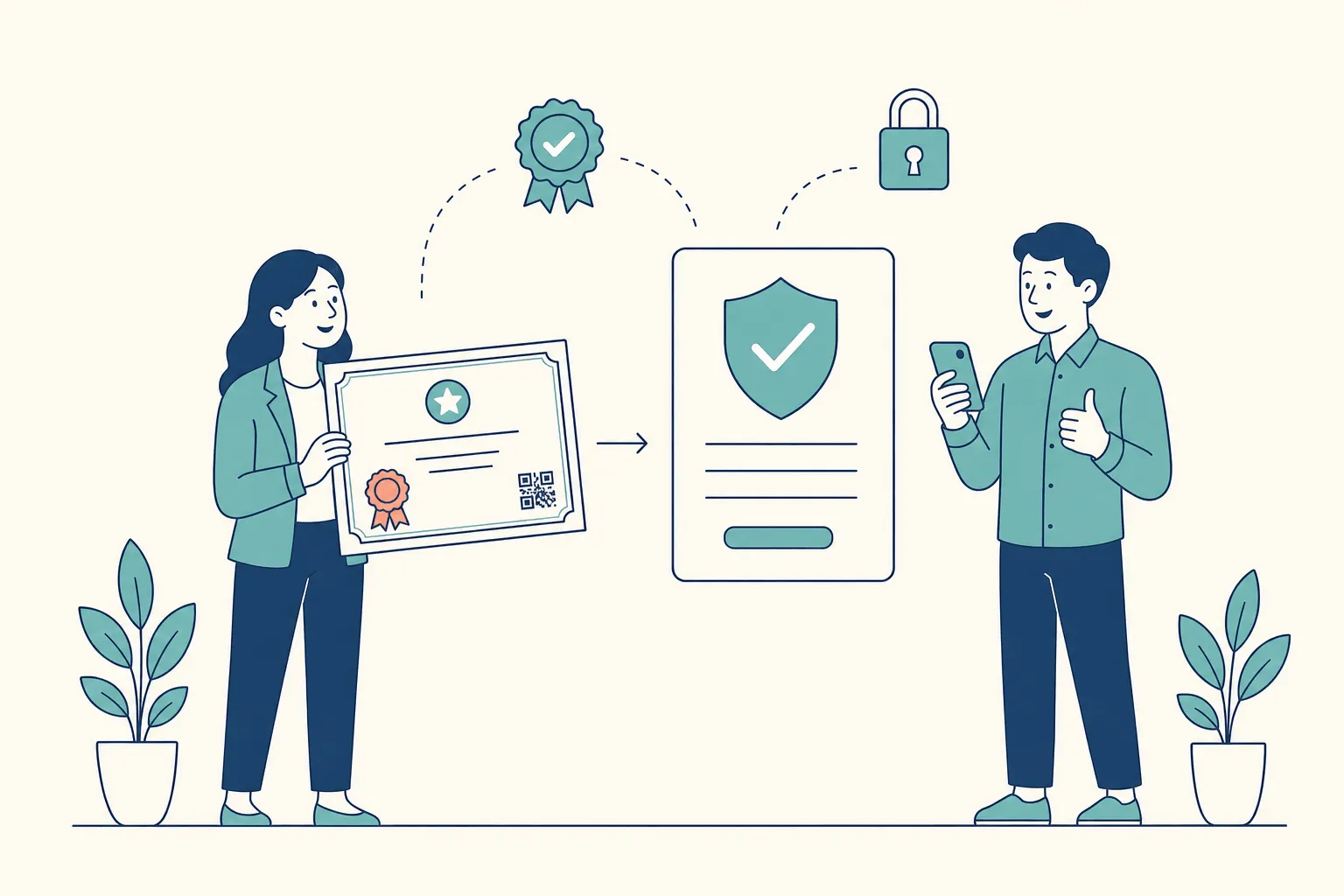
A certificate is a formal, issuer-signed record confirming that a specific person met a specific requirement. That’s the whole definition. Everything else — the border, the seal, the signature line — is presentation.
The interesting part is what happens after someone receives one. You finish a course, a workshop, a bootcamp, or a compliance module, download a polished PDF, and then wonder what it’s actually worth. Will a hiring manager understand what it proves? Can they confirm it came from the organization named on it? Does it show you learned something, or only that you showed up?
Those questions are the real subject. A certificate is a compact trust signal passed between three parties: the person who earned it, the organization that issued it, and whoever has to evaluate it later. It works when all three links hold. It fails — quietly, and usually without anyone telling you — when the third one doesn’t.
A certificate is trusted proof of a defined achievement, issued by an authority whose identity and standards can be checked.
Certificates are not a niche credential. The National Center for Education Statistics reports that U.S. postsecondary institutions conferred 5.1 million awards in 2021–22, of which roughly 1.0 million were certificates — about 5% more than a decade earlier. Outside formal education, the volume is larger and growing faster: 1EdTech’s 2025 Badge Count found that badges reported by respondents rose from 521,000 distinct badges in 2022 to 1,708,774 in 2025, with badges actually issued climbing from 74.7 million to 320.4 million.
This guide treats a certificate as trust infrastructure rather than a document: what it claims, how the types differ, where paper and digital diverge, how verification actually works, and why a genuine certificate can still vanish inside a hiring workflow.
What a certificate actually proves
Consider Maya, who has just finished an employer-sponsored project management program. Her training provider sends a certificate with her name, the program title, an issue date, and an authorized signature. She attaches the PDF to a job application. The hiring manager opens an image file — no issuer link, no way to confirm anything, no context about what Maya had to do to earn it.
Maya has proof. The proof isn’t doing any work.
The gap is that a certificate makes a claim, and a claim needs enough surrounding detail for someone else to weigh it. A useful certificate answers six questions:
- Who earned it? The recipient’s name, spelled the way it appears everywhere else.
- What was achieved? A title that identifies the course, program, skill, or milestone.
- Who issued it? An organization that can be identified independently of the document.
- When was it issued? Dates give context and signal whether the achievement is current.
- Under what criteria? Strong credentials state the completion requirements, assessment, or conditions.
- How does someone verify it? A link, identifier, or issuer-controlled record a third party can check.
A certificate reading “Thank you for participating” makes a much narrower statement than one describing assessed learning outcomes. Both can be entirely authentic. Trouble starts when the visual design implies a level of mastery the wording never claimed — a heavy gold seal on an attendance record reads as authority it doesn’t have.
The issuer determines the weight
A university certificate, a regulated professional body’s certificate, an employer training certificate, and an event participation certificate can all be genuine while making completely different claims. The issuer functions as a witness. Maya can say “I completed advanced project management training.” The issuer adds an independent statement connecting her to a named program and its stated result. The employer then judges whether that issuer and that achievement fit the role.
A document is not the same as proof
A PDF displays certificate information. It doesn’t establish authenticity. Names, dates, and templates can be edited or reused, and a scanned image of a real certificate is indistinguishable from a scanned image of a fabricated one. Real trust connects the visible record to a verification process the issuer controls — which is where the design and the infrastructure meet, and why certificate design decisions affect whether something can still be checked two years later.
Certificate, certification, badge, micro-credential
Most confusion about credentials comes from treating these four words as synonyms. They overlap, but each signals a different scope of claim.
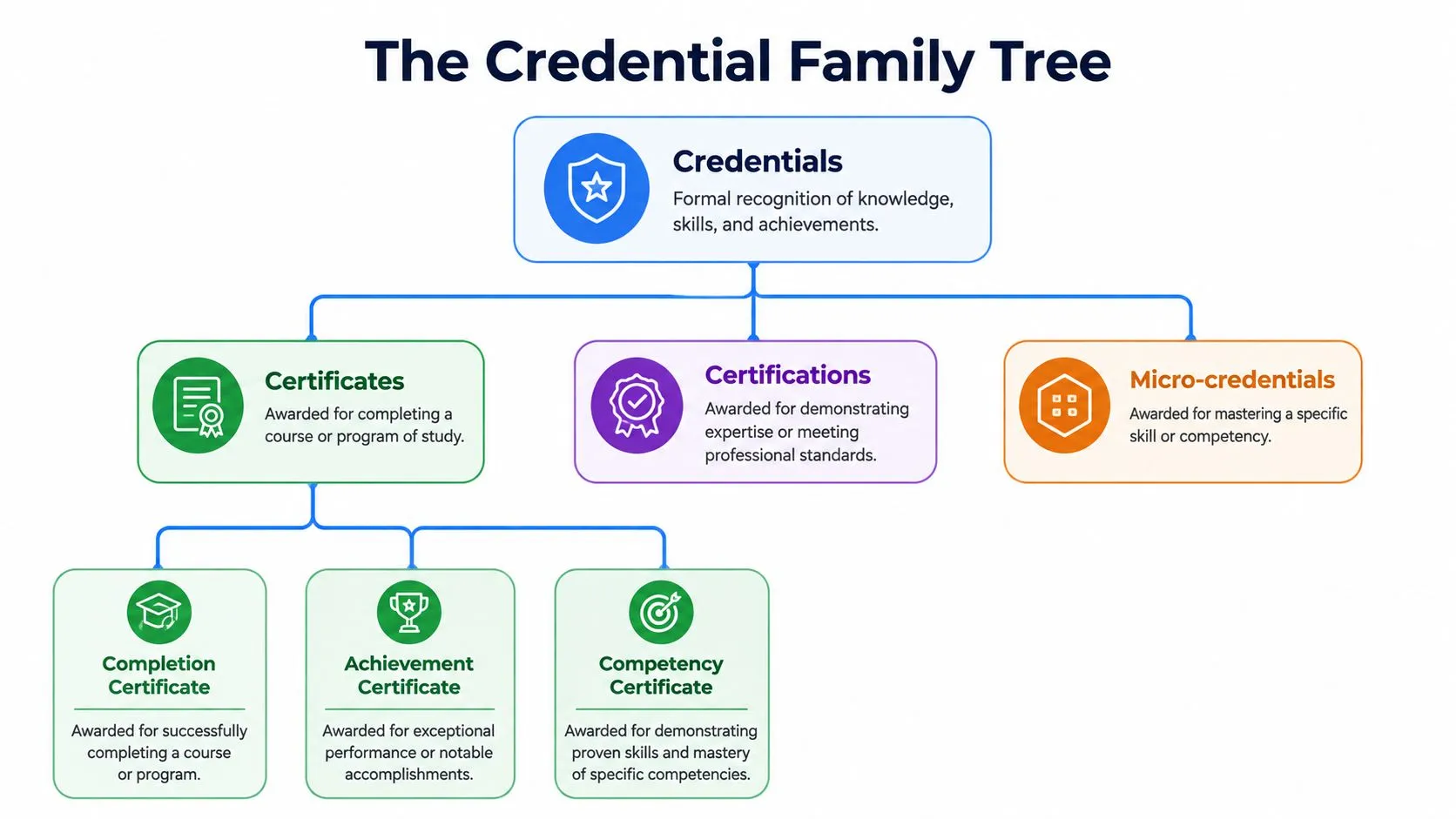
A completion certificate confirms someone finished a defined course or program. The claim is about the curriculum, not the outcome. This is the right choice when full participation is what you’re actually recognizing — the mechanics are covered in how to create a certificate of completion.
An achievement certificate recognizes a result or milestone: a capstone, an award, a program target reached. See certificate of achievement templates for how the language differs from completion.
A competency certificate makes the strongest claim of the three. It states that the recipient demonstrated a skill or body of knowledge against criteria the issuer established. It should name the assessment or standard, because “completed training” and “demonstrated competence” are not interchangeable statements.
A certification usually indicates that a person met requirements set by a certifying body — typically an examination, a practical evaluation, documented experience, or ongoing continuing-education obligations. The exact meaning is field-specific. If you’re building one, how to launch a certification program covers the governance that has to sit underneath it.
A digital badge represents a more focused achievement and usually carries metadata describing the issuer, criteria, evidence, and date. Badges are granular and stackable in a way certificates generally aren’t. Digital badges vs digital certificates walks through choosing between them, and often the answer is both.
A micro-credential describes the scope of an achievement rather than a file format. It can be delivered as either a badge or a certificate.
Types by issuer and purpose
- Academic certificates document focused study through a college, university, or education provider.
- Professional certificates show completion of role-related learning or development.
- Corporate certificates recognize internal training, onboarding, compliance learning, and career development — training certificate templates covers the recurring formats.
- Event certificates record attendance, contribution, or participation at a conference, seminar, or workshop.
- Recognition certificates acknowledge contribution or service rather than learning; see how to create a certificate of recognition.
- Skill badges signal narrower abilities that can accumulate toward a larger credential.
Choose the claim before the template. If a learner watched lessons and submitted activities, “completion” is accurate. If they passed a practical assessment, say so. Overstating a small credential is the fastest way to make a real one look inflated.
Paper and digital certificates work differently
Paper and digital certificates can describe the same achievement while delivering trust in completely different ways. Paper depends on physical presentation. Digital depends on structured data and an accessible verification experience.
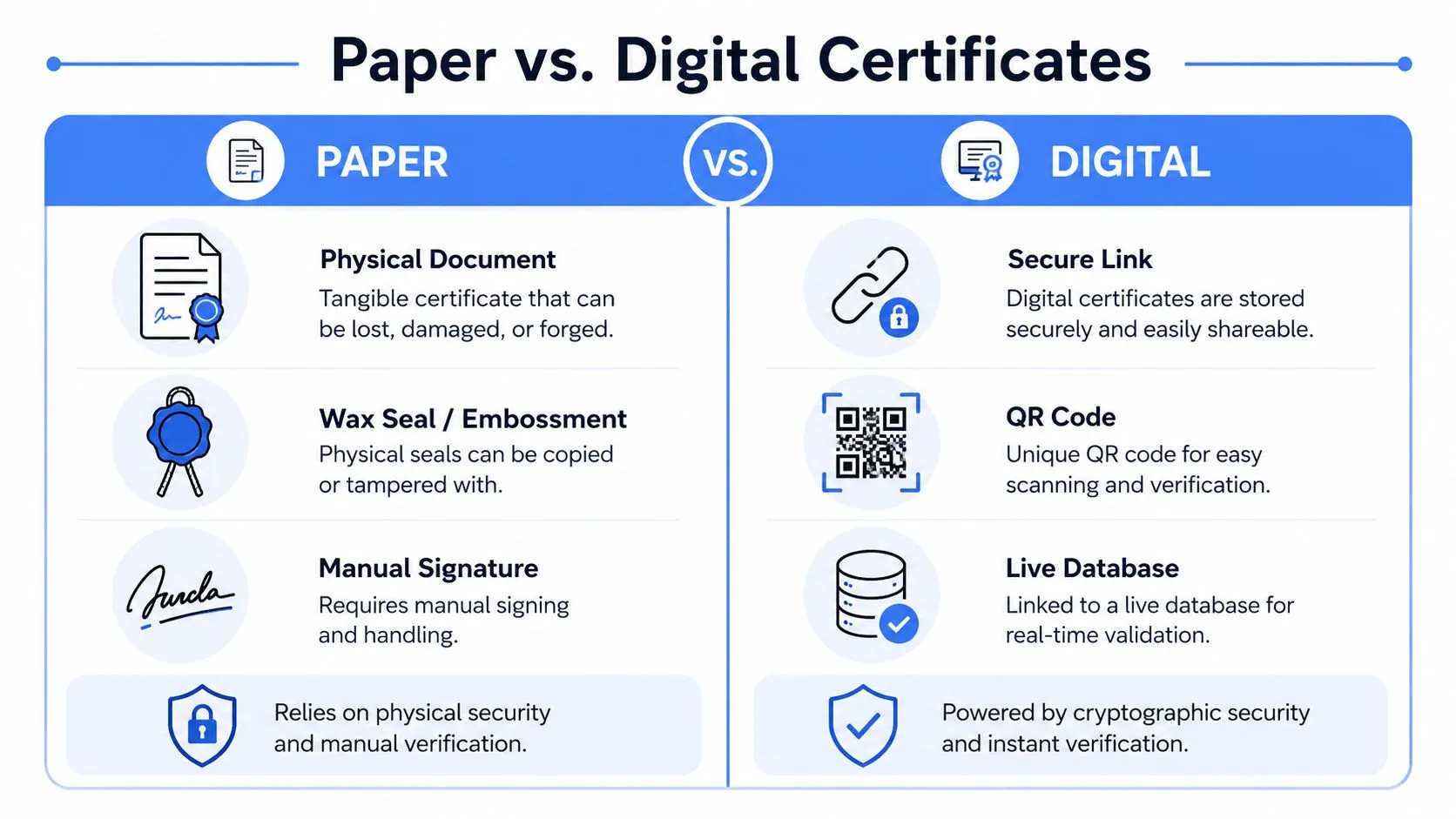
| Paper certificate | Digital certificate |
|---|---|
| Relies on printed design, signatures, seals, and controlled stock | Carries a unique URL, QR code, identifier, and cryptographic proof |
| Verification means manual inspection or contacting the issuer | Verification happens through an issuer-controlled online record |
| Easy to display physically | Easy to share into applications, profiles, email, and messages |
| Vulnerable to loss, damage, copying, and alteration | Shows current status; supports revocation and re-issuance |
| Suits ceremonies, offices, and physical records | Suits distributed hiring, learning, and professional workflows |
Paper still has a real job. A graduate frames a certificate. An instructor hands one to a workshop participant. Physical presentation makes an achievement feel meaningful in a way a URL doesn’t.
Its weakness is verification at distance. An employer in another city has no way to judge whether a signature is genuine, whether a seal means anything, or whether the document was modified after issue. Manual confirmation costs real time, and it scales badly when an applicant submits several credentials at once.
Digital delivery removes that friction — when it’s built properly. A recipient shares a link instead of an attachment. An evaluator opens the record, reviews the issuer, and checks whether the credential is still valid. A QR code connects a printed copy back to the same online record, so printing doesn’t have to mean abandoning verification.
Digital does not automatically mean trustworthy. A JPEG emailed from a training provider is no easier to authenticate than a scanned paper document. The difference comes from four things specifically: verifiable data, recipient access, issuer control, and current status.
Start the format decision from the audience. If certificates will be handed out at an in-person ceremony, paper serves a genuine purpose. If learners need to apply for jobs, move between platforms, and share achievements over years, a digital credential — or a printed one linked to a live verification record — is the practical choice. Teams turning course records into shareable credentials can compare workflows in how to issue digital certificates.
How certificate verification builds trust
Verification is what turns Maya’s PDF into evidence an employer can examine. It has to be easy enough that she’ll share it and rigorous enough to protect the issuer’s reputation.
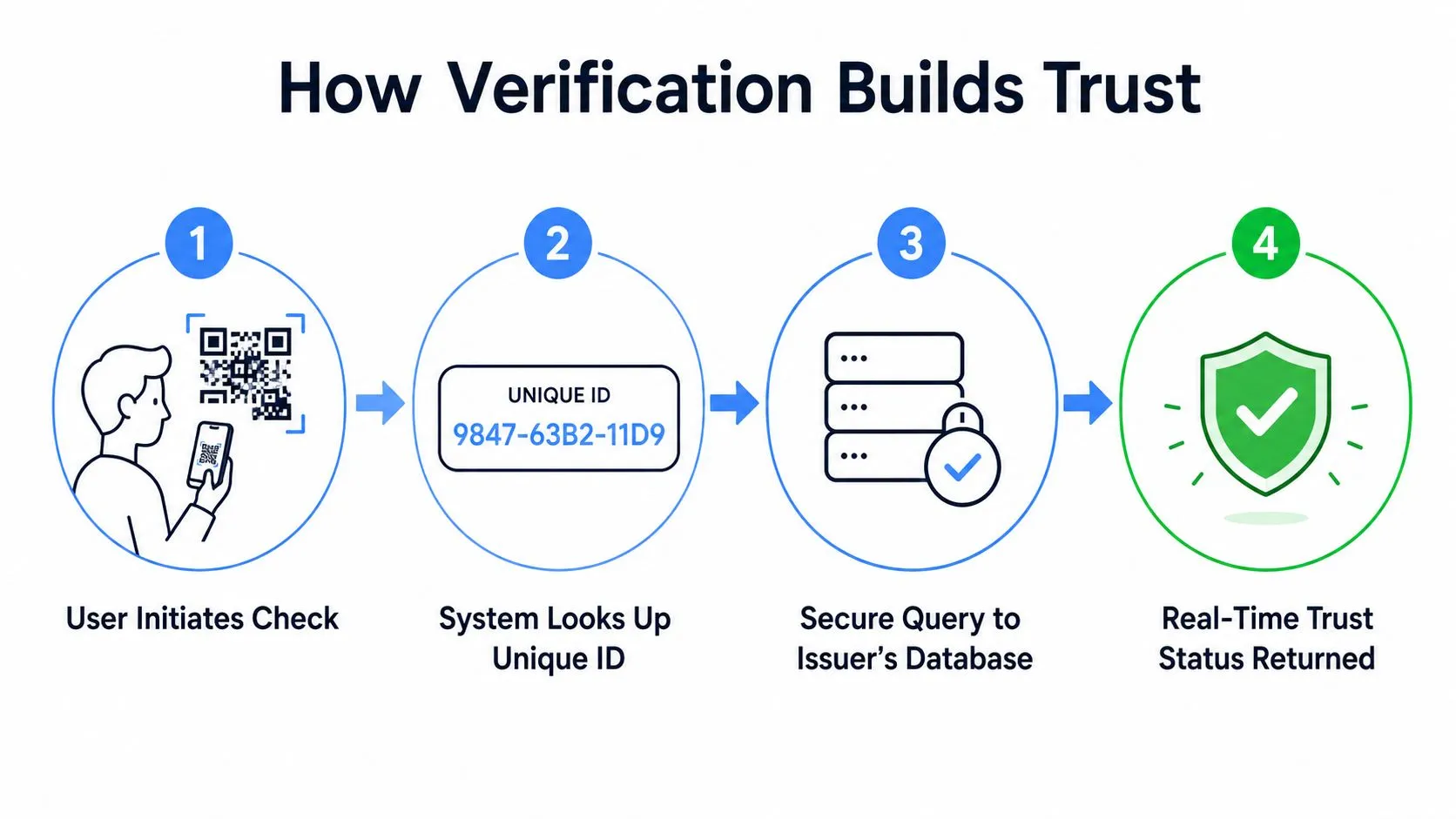
A typical digital check follows a short path:
- The verifier scans a QR code or opens a shared URL.
- The system resolves the credential through its unique identifier.
- The verification page displays recipient, achievement, issuer, and dates.
- The system confirms the record has not been altered since issue.
- The page shows whether the issuer currently recognizes the credential.
- The verifier decides how the achievement relates to the role.
Step five is the one most systems skip, and it’s the one that makes revocation mean something. A credential that can be issued but never withdrawn is a record, not a credential.
Crucially, all of this should work without the verifier creating an account. A login wall converts a five-second check into a decision not to check.
The cryptographic layer
A digital signature reveals changes made after issuance. If someone edits Maya’s name or the program title, the integrity check no longer matches the original record. But a signature is only half the story — the verifier also needs assurance that the signing key genuinely belongs to the stated issuer.
A green “valid” badge on its own doesn’t provide that. The W3C Verifiable Credentials Data Model defines verification as checking that the credential conforms to the specification, that the proof method is satisfied, and that the status check succeeds — and it draws an explicit line between verification (this is an authentic statement from this issuer) and validation (this statement is fit for my purpose). Status is a separate concern with its own machinery; the W3C’s Bitstring Status List exists so a verifier can tell whether a credential has been revoked or suspended without contacting the issuer directly.
Some environments use a chain of trust instead. In X.509-based systems, described in RFC 5280, the verifier checks each certificate in a path using the public key from the preceding one, continuing until it reaches a trusted anchor, and factors in validity periods and revocation status along the way.
The mental model is a building security desk. Staff check the badge, confirm who issued it, see whether it’s still active, and compare it against the person holding it. A convincing-looking badge proves nothing. The four checks do.
What employers should look for
- A recognizable issuer that can be identified independently of the certificate itself.
- Defined criteria explaining what completion, assessment, or achievement required.
- A stable verification route — a link or QR code leading to an issuer-controlled record.
- Current status, showing whether the credential is active, expired, revoked, or replaced.
- Recipient control, so the learner can access and share it without a hidden account.
- Consistent details across the certificate face and the verification page.
Organizations rebuilding this part of their process can compare approaches in 10 credential verification services.
Why certificates matter now — and why good ones still get missed
A certificate can be completely authentic and still fail to influence a hiring decision. The problem usually isn’t acceptance. It’s visibility.
Survey data in Accredible’s 2025 State of Credentialing Report found that 91% of employers actively look for digital credentials and 86% say they’d be more likely to interview someone whose credential proves a key skill. Yet only 46% regularly see digital credentials in applications. That gap is the story: demand is not the constraint, transport is.
It reframes the question. Instead of “does this person have a certificate?”, both sides should be asking “can the hiring workflow find, open, and verify it?”
The learner’s side
Maya’s project management certificate becomes useful the moment she can share a recipient-owned credential rather than attach an unexplained PDF. A recruiter opens it from the application, sees what she completed, and confirms the issuer without sending a separate email.
Portability compounds. The same credential appears on a professional profile, in a portfolio, inside an application, and in a direct message to a hiring manager. She never has to reconstruct the evidence.
The employer’s side
Employers need signals that are both relevant and trustworthy, and the trust problem is measurable. The same report found 84% of HR and talent leaders have caught or suspected a candidate of exaggerating qualifications. HireRight’s 2025 Global Benchmark Report points the same direction: more than three-quarters of businesses uncovered at least one candidate discrepancy during screening in the previous 12 months, with education and employment claims among the most common.
Verifiable certificates don’t replace interviews, references, or work samples. They give hiring teams a cheaper, faster starting point — and they shift the burden of proof from “trust this PDF” to “check this record.”
A short checklist, depending on which side you’re on
If you’re earning one. Read the criteria before you enrol, and know whether the outcome is participation, completion, achievement, or demonstrated competency. After you receive it, save the original, test the verification link yourself, and share the version that gives an employer enough context to interpret it.
If you’re issuing them. Start from the claim, not the template. Write the achievement in plain language, name the issuer clearly, include the relevant dates, and don’t imply assessment where none occurred. Then decide how recipients will receive, keep, share, and verify it — that decision matters more than the border you pick. You can build the design in the certificate maker or start from the template library, then issue a cohort from CSV, Google Sheets, Zapier, or the REST API using the bulk generator.
If you’re evaluating them. Treat a certificate as evidence, not a verdict. Confirm the issuer and current status, read the stated criteria, and connect the achievement to what the role actually requires.
It’s also worth auditing your own credential lifecycle honestly. Does staff manually assemble files? Can recipients share credentials without logging in? Do revoked credentials visibly update? Can program managers see delivery and engagement? If the answers are no, the weakness is infrastructure — not learner achievement.
A certificate earns attention when it makes a specific achievement easy to understand and easy to trust.
Frequently asked questions
What is a certificate, in one sentence?
A formal statement from an issuer that a named person met a defined requirement, ideally backed by a record a third party can check.
What’s the difference between a certificate and a certification?
A certificate documents completion of a program or achievement of a milestone, awarded by whoever ran it. A certification indicates a person met standards set by a certifying body, usually through examination or evaluation, and often carries renewal requirements. Certificates say what you did; certifications say what you can do, according to someone whose job is to define the standard.
Is a certificate of participation worth anything?
Yes, for what it actually claims: that you attended or took part. It’s legitimate evidence of engagement and it belongs on a professional development record. It stops being useful the moment it’s presented — or designed — as proof of assessed skill.
Do certificates expire?
Some do and some don’t. Compliance training, safety credentials, and most professional certifications carry expiry or renewal requirements. Course completion certificates usually don’t expire, though their relevance fades as fields move. Either way, the verification record should show current status, not just the original issue date.
How can I tell if a certificate is real?
Check the issuer independently, then use the verification route on the credential itself — a QR code or a link that leads to a page controlled by the issuer, not by the recipient. Confirm the name, title, dates, and issuer match across the certificate and that page, and that the page reports the credential as currently active. A PDF alone verifies nothing.
Do I need blockchain to make a certificate verifiable?
No. What you need is cryptographic signing plus a live status record, so a credential can be checked for tampering and for revocation. Blockchain anchoring is one way to publish tamper evidence, but it doesn’t solve revocation on its own and it isn’t a prerequisite.
Can a printed certificate still be verified?
Yes, if the design carries a QR code with enough quiet zone to scan reliably and a human-readable credential ID beside it for anyone working from a photocopy. Test this from an actual printout before launch — it’s the single most common thing teams discover afterward.
The short version
A certificate is a formal statement from an issuer about a recipient’s defined achievement. Its value comes from the relationship between the claim and the authority behind it, and no amount of design substitutes for that.
The complete picture has six parts: meaning (what was completed, achieved, or demonstrated), authority (who stands behind it), format (paper for display, digital for sharing and structured verification), integrity (signatures and issuer-controlled records that reveal changes), status (expiry, revocation, and re-issuance keeping the record current), and visibility (whether the credential reaches the systems and people evaluating learners).
The practical definition of a certificate is therefore simple but consequential: trusted proof of a stated achievement. The modern version goes further by making that proof portable, verifiable, current, and useful inside the workflows where decisions actually get made.
CertSeal helps training providers, institutions, employers, and event organizers design and issue digital certificates and badges with shareable URLs, QR-based verification, bulk delivery, revocation controls, and credential analytics. Try the free certificate generator with no account, or see pricing for full programs.
Start free with CertSeal — 100 verifiable certificates a year, no credit card.
Related reading
- Digital badges vs digital certificates — which format to issue, and when to issue both
- How to issue digital certificates in 2026 — delivery, verification, and analytics end to end
- 10 credential verification services, compared — how the platforms differ on speed and portability
- How to design a certificate that looks professional — hierarchy, contrast, and the verification block
- How to launch a certification program in 2026 — the governance behind a stronger claim
Keep reading
Certificates
Completion of course certificates: a practical issuer guide
What a completion of course certificate actually claims, the five fields it needs, static PDF vs verifiable credential, and how to run an issuance process you can still defend two years later.
Verification
Dynamic QR codes for verifiable credentials
How dynamic QR codes keep printed credentials verifiable: the two-layer architecture, the trust dependencies it creates, design constraints that survive a printer, and the governance rules large programs need.